

Revision Total Ankle Replacement
Revision Total Ankle Replacement in Colorado Springs, CO
If you are experiencing pain, instability, or complications after a previous ankle replacement, revision total ankle replacement may help restore mobility and improve your quality of life. At Colorado Springs Orthopaedic Group, our experienced orthopaedic specialists provide advanced evaluation and treatment for failed ankle replacements, helping patients throughout Colorado Springs and the surrounding communities return to more comfortable movement.
Revision total ankle replacement is a complex procedure designed to address issues such as implant loosening, wear, infection, malalignment, or persistent pain following a primary ankle replacement. Using advanced imaging, personalized surgical planning, and comprehensive rehabilitation programs, our team delivers expert care tailored to your unique needs.
Whether you are seeking relief from chronic ankle pain or exploring options after a failed ankle replacement, Colorado Springs Orthopaedic Group offers specialized foot and ankle care close to home.
-
Send a Referral
-
Send Medical Records
-
Additional InquiresEmail us at [email protected]
Colorado Springs Orthopaedic Group
Your feet and ankles provide the foundation for movement and are essential for walking, standing, working, exercising, and participating in sports. Injuries and conditions affecting these areas can make even simple daily activities painful or difficult.
CSOG provides specialized care for a broad range of foot and ankle conditions, including fractures, arthritis, tendon and ligament problems, deformities, sports injuries, and other disorders affecting mobility. Our specialists offer both nonsurgical and surgical treatment options based on your individual condition.
Treatment may include physical therapy, activity modification, bracing, injections, minimally invasive procedures, or advanced surgery when appropriate. Our goal is to relieve pain, restore stability and function, and help you get back on your feet and return to the activities you enjoy.
What is Revision Total Ankle Replacement?
Revision total ankle replacement is a surgical procedure to replace a failed or malfunctioning ankle prosthesis from a previous ankle replacement surgery.
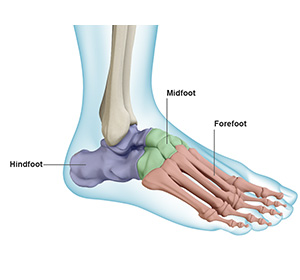
The ankle joint connects the leg with the foot and provides free movement to the foot. It is formed by connecting the bones of the lower leg, tibia and fibula, with the talus or ankle bone. The surface of the ankle bones is covered with articular cartilage. Damage to the cartilage leads to an arthritic ankle, which results in pain and impaired movement of the ankle.
Ankle joint replacement, also known as total ankle arthroplasty, is a surgical procedure performed to relieve pain and immobility due to ankle arthritis. The procedure involves replacing the damaged or arthritic ankle joint with an artificial joint (prosthesis) to restore ankle function. A total ankle replacement prosthesis is comprised of 3 different segments: A titanium metal component that is attached to the tibia, a cobalt-chrome piece that is connected to the talus, and a polyethylene (plastic) implant that is placed between the two.
Indications for Revision Total Ankle Replacement
Indications for revision total ankle replacement typically involve complications related to a previously performed primary ankle replacement. These may include:
- Implant Loosening: Over time, the components of the initial ankle replacement may become loose, leading to pain and instability.
- Malalignment: Misalignment of the implant can lead to uneven wear and increased stress on surrounding bones.
- Infection: A deep infection in the joint may require removal of the implant, thorough cleaning, and re-implantation.
- Implant Wear: Polyethylene (plastic) wear in the implant can cause particle debris, leading to inflammation and bone loss (osteolysis).
- Persistent Pain or Functional Limitation: Some patients continue to experience significant pain or limited mobility after the initial replacement.
Preparation for Revision Total Ankle Replacement
In general, preparation for revision total ankle replacement may include the following:
- The surgeon conducts a comprehensive medical evaluation, including physical examination, review of your medical history, medications, and allergies. Blood tests may also be done to rule out infection and other conditions such as anemia.
- A detailed assessment of the ankle, including imaging (X-rays, CT, or MRI) is performed to evaluate bone quality, implant position, and any areas of bone loss or infection.
- Certain medications, especially blood thinners, may need to be adjusted or paused before surgery to reduce bleeding risks. Patients are advised to review all medications, including supplements, with their medical team.
- Patients are often advised to stop smoking, as smoking can impair bone healing and increase the risk of complications.
Procedure for Revision Total Ankle Replacement
In general, procedure for revision total ankle replacement may involve the following steps:
- The patient receives general or regional anesthesia, depending on the surgeon’s recommendation and the patient’s health.
- The surgeon makes an incision near the ankle joint to expose the initial implant and surrounding structures.
- Specialized instruments are used to remove the components of the original ankle implant while ensuring minimal damage to soft tissues, nerves, and blood vessels.
- If infection is a reason for revision, the surgeon removes any infected or necrotic tissue. In some cases, a temporary antibiotic spacer is inserted to treat the infection before placing a new implant in a staged surgery approach.
- If there is bone loss (osteolysis), the surgeon may perform bone grafting to restore bone volume and provide support for the new implant. Bone grafts can be from the patient (autograft), a donor (allograft), or a synthetic source.
- Depending on the assessment, standard or custom implants are selected. Custom implants may be used if there is extensive damage or unique anatomy from the prior surgery.
- The new tibial and talar components are carefully positioned and secured, ensuring a stable fit. This may involve cementing or press-fitting the components based on the type of implant used.
- A spacer made of polyethylene (highly durable plastic) is placed between the metal components to allow for smooth joint motion and reduce wear.
- After ensuring proper alignment and stability, the incision is closed in layers with sutures or staples.
Postoperative Care and Recovery
After the surgery, the patient is moved to a recovery room where they are monitored as anesthesia wears off. A splint or brace is typically applied to immobilize the joint and protect the new implant in the initial healing phase. Some patients may also be placed in a cast for additional stability. Patients are typically non-weight-bearing on the affected leg. Weight-bearing protocols are gradually increased based on the surgeon's plan and the patient’s progress. A physical therapist will guide exercises to improve range of motion, build strength, and assist with the transition to partial and full weight-bearing over several weeks to months. Follow-up appointments will be scheduled to monitor your progress, address any concerns, and adjust the rehabilitation program as needed.
Risks and Complications
Revision total ankle replacement carries a higher risk of complications compared to a primary ankle replacement due to the complexity of the procedure, bone loss, and scar tissue from prior surgery. In general, risks and complications associated with revision total ankle replacement include:
- Infection
- Bleeding
- Implant loosening
- Alignment and stability issues
- Nerve and blood vessel damage
- Blood clots (Deep Vein Thrombosis or DVT)
- Delayed bone healing or nonunion
- Persistent pain and limited range of motion
For more information about our services or to schedule an appointment, call us at or click here to request an appointment online. We'll respond to you as soon as possible.




Why Choose Colorado Springs Orthopaedic Group for Revision Total Ankle Replacement?
Choosing the right surgeon for revision ankle replacement is critical due to the complexity of the procedure. At Colorado Springs Orthopaedic Group, our specialists are experienced in diagnosing and treating failed ankle replacements and developing customized treatment plans for each patient.
Patients choose our practice because we offer:
- Fellowship-trained orthopaedic specialists with expertise in complex foot and ankle reconstruction
- Comprehensive evaluation of failed ankle replacement implants
- Advanced diagnostic imaging and surgical planning
- Personalized treatment options tailored to your condition and goals
- Coordinated rehabilitation and recovery support
- Patient-centered care focused on restoring function and reducing pain
- Convenient access to specialized orthopaedic care in Colorado Springs
Our goal is to help you regain mobility, improve ankle stability, and return to the activities you enjoy with confidence.
Revision Total Ankle Replacement FAQs
Find Expert Revision Ankle Replacement Care in Colorado Springs
If you are experiencing ongoing ankle pain or complications after a previous ankle replacement, the specialists at Colorado Springs Orthopaedic Group can help. Our team provides comprehensive evaluation, advanced revision ankle replacement procedures, and personalized treatment plans designed to restore mobility and improve your quality of life.
Schedule a consultation today to learn more about revision total ankle replacement in Colorado Springs, CO, and explore your options for lasting ankle pain relief and improved function.