Big Toe Arthroscopy
Colorado Springs Orthopaedic Group
Your feet and ankles provide the foundation for movement and are essential for walking, standing, working, exercising, and participating in sports. Injuries and conditions affecting these areas can make even simple daily activities painful or difficult.
CSOG provides specialized care for a broad range of foot and ankle conditions, including fractures, arthritis, tendon and ligament problems, deformities, sports injuries, and other disorders affecting mobility. Our specialists offer both nonsurgical and surgical treatment options based on your individual condition.
Treatment may include physical therapy, activity modification, bracing, injections, minimally invasive procedures, or advanced surgery when appropriate. Our goal is to relieve pain, restore stability and function, and help you get back on your feet and return to the activities you enjoy.
What is Big Toe Arthroscopy?
Big toe arthroscopy is a minimally invasive surgical procedure in which an arthroscope - a thin telescope-like instrument with a light and video camera on the end - is inserted into the big toe to evaluate and treat a variety of conditions. The camera projects an image of the inside of the big toe onto a large monitor, allowing your surgeon to look for any damage, assess the type of injury, and repair the problem accordingly.
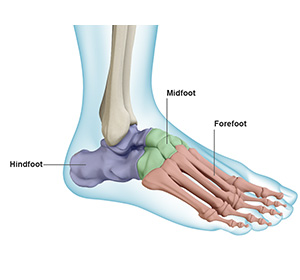
The first toe, also known as the hallux ("big toe" or "great toe"), is one of 5 digits found on the front of the foot. The big toe is the innermost and largest toe of the foot. It is made up of 2 toe bones called phalanges. The 2 phalanges (known as proximal and distal phalanx), comprise the interphalangeal joint of the hallux. The first metatarsophalangeal joint (or 1st MTPJ) is the joint between the first metatarsal and the big toe. Underneath the 1st metatarsal head are typically 2 small, rounded bones known as sesamoids. Ligaments and muscles attach to the 1st MTPJ and perform a crucial role in both normal and abnormal functions of this joint.
Indications for Big Toe Arthroscopy
Big toe arthroscopy is usually indicated for the treatment of arthritis of the big toe (hallux rigidus). Hallux rigidus is sometimes referred to as turf toe or stiff big toe. Arthritis of the big toe is a gradual loss of cartilage around the joint at the base of the big toe causing the bone surfaces to become irregular and rub against each other, resulting in significant pain, swelling, stiffness, and reduced joint function.
Your physician may recommend big toe arthroscopy to evaluate the condition of the arthritic joint and to provide a minimally invasive solution to it when signs and symptoms of big toe arthritis have not responded effectively to conservative treatment such as medications and physical therapy.
Other common indications for big toe arthroscopy include:
- Post-traumatic joint pain
- Osteochondral or chondral defects – damage or injury to an area of smooth articular cartilage with the underlying bone.
- Loose bodies (fragments of cartilage or bone that float freely within the synovial fluid)
- Synovitis (inflammation of the synovium)- Synovium is a connective tissue that lines the inside of the joint capsule.
Preparation for Big Toe Arthroscopy
Preparation for big toe arthroscopy may involve the following steps:
- A review of your medical history and a physical examination are performed by your doctor to check for any medical issues that need to be addressed prior to the surgery.
- You may need to undergo tests such as bloodwork and imaging to screen for any abnormalities that could compromise the safety of the surgery.
- You should inform your doctor if you have allergies to medications, anesthesia, or latex.
- You should also inform of any medications or supplements you are taking or any conditions you have such as heart or lung disease.
- You may be asked to refrain from certain medications such as blood thinners, anti-inflammatories, or supplements for a week or two prior to the surgery.
- You should refrain from alcohol or tobacco at least a few days before surgery and several weeks after, as it can hinder the healing process.
- You should arrange for a family member or a friend to drive you home after the surgery.
- A signed informed consent will be obtained from you after the surgery has been explained in detail.
Procedure for Big Toe Arthroscopy
In general, the minimally invasive big toe arthroscopy procedure will involve the following steps:
- You will be placed in a supine (face-up) position on the procedure table with your foot held in an optimal position to facilitate surgery.
- Two to three small surgical incisions called portals are made around the big toe.
- An arthroscope is inserted through one of the portals to provide images of the joint on the monitor for your surgeon to view. Sometimes, surgical microscopes may also be used to magnify the visual field.
- Specialized miniature instruments are then introduced into the joint through other portals, and based on the condition of the big toe, your surgeon performs the required repair.
- The instrument most commonly employed in an arthroscopic procedure is called a shaver, which is utilized to clean and suction out the build-up of scar tissue, loose cartilaginous fragments, and/or overgrowth of unwanted tissue that is impinging and causing pain in the toe joint.
- Once the arthroscopic repair is complete, the various instruments are removed, and the incisions are closed and covered with surgical tapes.
Postoperative Care and Instructions
In general, postoperative care instructions and recovery after big toe arthroscopy may involve the following steps:
- You will be transferred to the recovery area where your nurse will closely observe you for any allergic/anesthetic reactions and monitor your vital signs as you recover.
- You may notice some pain, swelling, and discomfort in the foot area. Pain and anti-inflammatory medications are provided as needed to address these.
- You are advised to keep your foot elevated as much as possible while resting to reduce swelling and pain.
- Your big toe will be secured with a dressing. Assistive devices such as an orthopedics boot or a cast will be applied for protection and to facilitate healing, along with instructions on restricted weight-bearing.
- You may need to stay in the hospital until you are able to safely walk with a cane, walker, or crutches.
- Instructions on surgical site care and bathing will be provided to keep the surgical site clean and dry.
- Refrain from strenuous activities such as running for the first few months and lifting heavy weights for at least 6 months. A gradual increase in activities over a period of time is recommended.
- An individualized physical therapy protocol may be recommended to help strengthen foot muscles and optimize foot function.
- Most patients are able to resume their normal activities in a month or two after surgery; however, returning to sports may take at least 6 months or longer.
- Refrain from driving until you are fully fit and receive your doctor’s consent.
- Periodic follow-up appointments will be scheduled to monitor your progress.
Risks and Complications
Big toe arthroscopy surgery is a relatively safe procedure; however, as with any surgery, some risks and complications may occur, such as the following:
- Nerve injury
- Pain and discomfort
- Joint stiffness
- Infection
- Numbness
- Bleeding
- Swelling and inflammation
- Thromboembolism or blood clots
Benefits of Big Toe Arthroscopy
Some of the benefits of minimally invasive big toe arthroscopy include:
- Reduced post-operative swelling, pain, and infection
- Minimal scarring
- Earlier mobilization
- Smaller incisions
- Lesser discomfort and faster recovery
- Less chances of injury to surrounding tissue, such as skin, ligaments, and tendon
For more information about our services or to schedule an appointment, call us at or click here to request an appointment online. We'll respond to you as soon as possible.
-
Send a Referral
-
Send Medical Records
-
Additional InquiresEmail us at [email protected]