Ankle Impingement
Colorado Springs Orthopaedic Group
Your feet and ankles provide the foundation for movement and are essential for walking, standing, working, exercising, and participating in sports. Injuries and conditions affecting these areas can make even simple daily activities painful or difficult.
CSOG provides specialized care for a broad range of foot and ankle conditions, including fractures, arthritis, tendon and ligament problems, deformities, sports injuries, and other disorders affecting mobility. Our specialists offer both nonsurgical and surgical treatment options based on your individual condition.
Treatment may include physical therapy, activity modification, bracing, injections, minimally invasive procedures, or advanced surgery when appropriate. Our goal is to relieve pain, restore stability and function, and help you get back on your feet and return to the activities you enjoy.
What is Ankle Impingement?
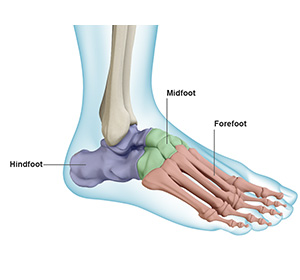
The ankle is made up of many bones, muscles, and ligaments that aid in the smooth movement of the foot. Ankle impingement is the painful limitation of movement of the ankle due to an abnormality in the soft tissue or bone. Impingement can occur in the ankle's front (anterior ankle impingement) or back (posterior ankle impingement).
Types of Ankle Impingement
Anterior Ankle Impingement: Anterior ankle impingement is seen in athletes whose actions involve repeated upward bending of the ankle. This causes irritation at the front edge, which in time can lead to impingement. Other causes may include excess scar tissue formed with the healing of an ankle sprain (stretched or torn ligament) or bone spurs formed due to continuous wear and tear of the bone. Anterior ankle impingement is also referred to as a footballer's ankle or athlete’s ankle. Anterior ankle impingement is most common in sports, such as:
- Football
- Basketball
- Volleyball
- Soccer
- Running
Posterior Ankle Impingement: Posterior ankle impingement is usually seen in ballet dancers who repeatedly stand on their toes. This causes tissues to get sandwiched and pinched between the tibia (lower leg bone) and heel bone leading to ankle impingement. Posterior ankle impingement is a relatively rare occurrence.
Symptoms of Ankle Impingement
Symptoms of ankle impingement include pain and swelling along the front and back of the ankle, which increases with movement. There may also be a painful clicking sensation when the foot is twisted inwards and outwards. Common symptoms also include:
- Tenderness to touch
- Swelling in front of the ankle
- Locking of the ankle joint
- Dull ache when resting
- Ankle weakness/loss of function
Diagnosis of Ankle Impingement
In order to diagnose ankle impingement, your doctor will ask questions about your injury, the symptoms you are experiencing, and the sports you are engaged in. A physical examination will be done to detect areas of tenderness and swelling. Your doctor will usually be able to diagnose the condition by moving the ankle through its full range of motion. The point of maximum tenderness is usually where the tissues are being pinched. This is confirmed by injecting a numbing agent to see if relief is achieved. X-rays and bone scans may also be ordered. Occasionally, an MRI is also used to evaluate other structures of the ankle.
Treatment for Ankle Impingement
Treatment may involve resting the ankle, use of ice packs to reduce swelling, placing the ankle in a cast or special boot to restrict movement, pain medications, physical therapy, and steroid injections into the painful area to promote faster healing. In case symptoms persist, surgical treatment may be required, which involves the excision of excess scar tissue, damaged tissue, bone spurs, or other abnormalities through a minimally invasive procedure. Following treatment, a period of physiotherapy rehabilitation is recommended to regain strength and flexibility of the joint.
For more information about our services or to schedule an appointment, call us at or click here to request an appointment online. We'll respond to you as soon as possible.
-
Send a Referral
-
Send Medical Records
-
Additional InquiresEmail us at [email protected]