Congenital Limb Deformities
Colorado Springs Orthopaedic Group
Your feet and ankles provide the foundation for movement and are essential for walking, standing, working, exercising, and participating in sports. Injuries and conditions affecting these areas can make even simple daily activities painful or difficult.
CSOG provides specialized care for a broad range of foot and ankle conditions, including fractures, arthritis, tendon and ligament problems, deformities, sports injuries, and other disorders affecting mobility. Our specialists offer both nonsurgical and surgical treatment options based on your individual condition.
Treatment may include physical therapy, activity modification, bracing, injections, minimally invasive procedures, or advanced surgery when appropriate. Our goal is to relieve pain, restore stability and function, and help you get back on your feet and return to the activities you enjoy.
What are Congenital Limb Deformities?
Limb deformities can be congenital (present at birth) or develop at a later stage because of a fracture, infection, arthritis or tumor.
Congenital deformities of the lower limbs are developmental disorders that cause alterations in the shape and appearance of the legs. Several factors, including genetics, influence the fetal growth in the womb, and exposure to teratogenic drugs and chemicals can increase the risk of congenital deformities.
What are the Types of Congenital Limb Deformities?
Some of the congenital deformities of the lower limbs include:
- Congenital talipes equinovarus: Congenital talipes equinovarus, commonly called clubfoot is the most common foot deformity. The feet are twisted inward and downward at the ankles in such a way that the ankle or side of the foot meets the ground while walking instead of the sole of the foot.
- Flatfoot: Also, known as pes planus, flatfoot is a deformity of the feet in which the arch running lengthwise along the sole of the foot has collapsed or has not formed at all. It may happen in one or both feet.
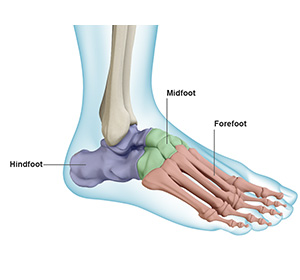
- Congenital vertical talus: Congenital vertical talus (CVT) is a rare condition in which the talus (heel bone) and navicular bones (ankle bone) are abnormally positioned. This leads to a rigid flatfoot with a rocker-bottom appearance. The hindfoot points downward to the floor while the forefoot points upwards. It occurs most frequently with other neuromuscular disorders such as spina bifida and arthrogryposis (multiple joint contractures present at birth).
- Calcaneovalgus foot: This postural deformity is located at the ankle joint, where the foot appears to be bent upwards. It occurs in newborns because of abnormal positioning in the womb.
- Congenital genu varus: Commonly called bowed legs, this is a condition seen in children below 2 years. The legs angle out at the knee joint in a way that a child stands with both feet joined and the knees apart. Generally, no treatment is required; the abnormality corrects as your child starts walking. Alternatively, special shoes, casts or braces may be ordered, or surgery performed in severe cases.
- Tarsal coalition: Tarsal coalition is a developmental deformity that occurs because of an abnormal connection between two bones at the back of the foot (tarsal bones). Most children with tarsal coalition are born with this condition, but symptoms usually appear between ages 9-16 once the bones mature.
- Metatarsus adductus: Metatarsus adductus is a common forefoot deformity where the bones in the front part of the foot are bent or turned inward, towards the body.
- Leg length discrepancy: Leg length discrepancy is a condition in which one leg is shorter than the other, leading to problems with posture and walking pattern. There may be associated pain in the back, hip, knee or ankle. It can be corrected by a reconstructive surgical procedure called limb lengthening.
For more information about our services or to schedule an appointment, call us at or click here to request an appointment online. We'll respond to you as soon as possible.
-
Send a Referral
-
Send Medical Records
-
Additional InquiresEmail us at [email protected]