Osteochondral Allograft Transplantation System (OATS) of the Ankle
Colorado Springs Orthopaedic Group
Your feet and ankles provide the foundation for movement and are essential for walking, standing, working, exercising, and participating in sports. Injuries and conditions affecting these areas can make even simple daily activities painful or difficult.
CSOG provides specialized care for a broad range of foot and ankle conditions, including fractures, arthritis, tendon and ligament problems, deformities, sports injuries, and other disorders affecting mobility. Our specialists offer both nonsurgical and surgical treatment options based on your individual condition.
Treatment may include physical therapy, activity modification, bracing, injections, minimally invasive procedures, or advanced surgery when appropriate. Our goal is to relieve pain, restore stability and function, and help you get back on your feet and return to the activities you enjoy.
What is OATS of the Ankle?
OATS of the ankle is a surgical procedure to treat Osteochondral Lesions of the Talus (OCL) or Osteochondritis Dissecans (OCD). It involves the transfer of healthy cartilage to replace the damaged cartilage and restore the normal function of the foot. The cartilage can be taken from your ankle joint (autograft) for smaller defects. An allograft (graft from a donor) is considered for large defects. During an OATS procedure, multiple, tiny plugs of healthy bone and cartilage are transferred and laid in a mosaic pattern, hence, the procedure is also known as mosaicplasty.
What are Osteochondral Lesions (OCL) / Osteochondritis Dissecans (OCD)?
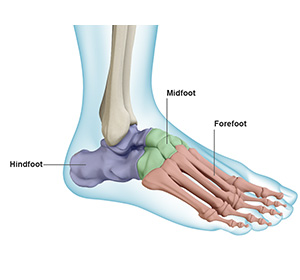
The tibia and the fibula bones of the lower leg join with the talus bone to form the ankle joint. The talus bone is an important bone located between the tibia and fibula and the heel bone (calcaneus). OCL or OCD is the damage to the cartilage and the talus bone of the ankle joint. Usually, the inner or the medial portion of the ankle is affected.
OCL may be genetic or may be caused due to trauma, stress fractures in sports, severe sprain, local osteonecrosis, etc. OCL lesions are sometimes asymptomatic. Large lesions are associated with symptoms such as localized ankle pain and discomfort which worsens while walking or running, a clicking or popping sound, swelling, tenderness, weakness of the foot, etc.
Indications for OATS Procedure
The OATS procedure is indicated for large ankle lesions that do not respond to non-surgical treatment methods involving the use of a cast, physical therapy, pain medications, strengthening exercises, etc. Lesions unresponsive to arthroscopic debridement and microfracture also may need the OATS procedure.
Preparation before Surgery
Before surgery, your doctor will perform a complete physical examination of your ankle. An X-ray, CT-scan, or MRI of your ankle will be ordered. Discuss with your doctor any allergies that you might have and medications you are taking to see which ones you should stop taking before surgery.
OATS Procedure
The surgery is performed under general anesthesia. It involves the following steps:
- An incision is made at the ankle joint. A few ligaments may be incised to expose the joint.
- Your surgeon performs debridement of the chondral surface to remove damaged cartilage. Some damaged bone may also be removed. Care is taken to prevent damage to healthy cartilage.
- An allograft is inserted at the damaged site. Fixation is performed with pins or screws. Your surgeon ensures proper fitting of the allograft.
- Intraoperative fluoroscopy is performed by your surgeon to confirm proper placement of the graft.
- The incision is closed and covered with a bandage.
Rehabilitation after OATS Procedure
- Your leg will be placed in a splint or short leg cast and you will be encouraged to keep weight off your leg for about 6-8 weeks.
- Physical therapy exercises will be taught to improve your flexibility, range of motion and strength of your foot.
- Regularly follow-up with your doctor. Imaging techniques such as X-ray, CT-scan or MRI may be ordered to ensure union of the allograft with the bone.
Outcome of OATS Procedure
Patients typically experience reduced pain with improvement in the movement and functioning of the foot. Complications are rare.
For more information about our services or to schedule an appointment, call us at or click here to request an appointment online. We'll respond to you as soon as possible.
-
Send a Referral
-
Send Medical Records
-
Additional InquiresEmail us at [email protected]