Metatarsalgia
Colorado Springs Orthopaedic Group
Your feet and ankles provide the foundation for movement and are essential for walking, standing, working, exercising, and participating in sports. Injuries and conditions affecting these areas can make even simple daily activities painful or difficult.
CSOG provides specialized care for a broad range of foot and ankle conditions, including fractures, arthritis, tendon and ligament problems, deformities, sports injuries, and other disorders affecting mobility. Our specialists offer both nonsurgical and surgical treatment options based on your individual condition.
Treatment may include physical therapy, activity modification, bracing, injections, minimally invasive procedures, or advanced surgery when appropriate. Our goal is to relieve pain, restore stability and function, and help you get back on your feet and return to the activities you enjoy.
What is Metatarsalgia?
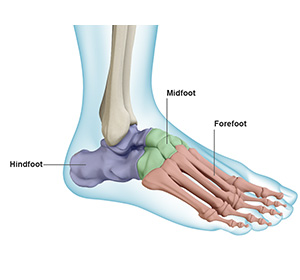
Metatarsalgia is a condition in which pain and inflammation are caused due to overuse or injury to the ball of the foot - the area between the toes and the arch. This condition mainly affects the joints at the base of the five-toe bones.
Causes of Metatarsalgia
Metatarsalgia can be caused by many factors, the most common including:
- Intense physical activity as in sports
- Ill-fitting shoes
- High-heeled footwear
- High-arched foot
- An unusually long metatarsal bone - usually of the second toe
- Toe deformities such as hammertoe
- Overlapping or underlapping toe
- Weak toe muscles
- A tight or short Achilles tendon
- Excess body weight
- Conditions such as arthritis, gout, Morton’s neuroma and bursitis
Symptoms of Metatarsalgia
Symptoms of metatarsalgia include:
- Pain in the ball of the foot, which feels like a deep bruise and worsens when you stand or walk, especially when barefoot
- Feeling like you have a stone at the base of your foot
- An area of hardened skin (callus) on the ball of the foot
- Swelling of the joints near the base of the toes (metatarsophalangeal joints)
Diagnosis of Metatarsalgia
Your doctor will discuss your symptoms and activities and perform a physical examination. Diagnostic tests that may be carried out include:
- X-rays: to identify any bone fractures
- Ultrasound: to evaluate soft tissue conditions such as bursitis or Morton’s neuroma
- MRI scan: to visualize the soft tissues surrounding the metatarsal bones
- Blood tests: such as uric acid levels to help detect conditions such as gout
Treatment for Metatarsalgia
Metatarsalgia is normally treated by conservative methods that include:
- Applying ice over the area of pain
- Taking medications to reduce pain and inflammation
- Changing footwear
- Using pressure bandages on the foot
- Using a metatarsal pad
- Losing bodyweight
- Avoiding barefoot walking
When conservative methods are not found to be effective, surgery may be recommended for removing calluses, correcting deformities and realigning the metatarsal bones.
For more information about our services or to schedule an appointment, call us at or click here to request an appointment online. We'll respond to you as soon as possible.
-
Send a Referral
-
Send Medical Records
-
Additional InquiresEmail us at [email protected]