Foot and Ankle Osteotomy
Colorado Springs Orthopaedic Group
Your feet and ankles provide the foundation for movement and are essential for walking, standing, working, exercising, and participating in sports. Injuries and conditions affecting these areas can make even simple daily activities painful or difficult.
CSOG provides specialized care for a broad range of foot and ankle conditions, including fractures, arthritis, tendon and ligament problems, deformities, sports injuries, and other disorders affecting mobility. Our specialists offer both nonsurgical and surgical treatment options based on your individual condition.
Treatment may include physical therapy, activity modification, bracing, injections, minimally invasive procedures, or advanced surgery when appropriate. Our goal is to relieve pain, restore stability and function, and help you get back on your feet and return to the activities you enjoy.
What is Foot and Ankle Osteotomy?
Foot and ankle osteotomy is a surgery performed to remove parts of a bone in your foot or ankle that might be causing pain or limiting your mobility. The surgery helps relieve pressure on the foot and ankle caused by the bone deformity or injury.
Anatomy of the Foot and Ankle
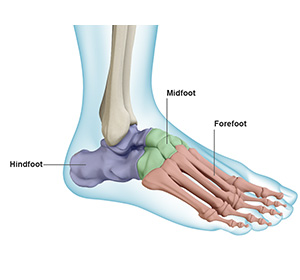
The foot and ankle consist of 26 bones, 33 joints, and many muscles, tendons, and ligaments. They form complex joints that are involved in movement and providing stability and balance to the body.
Indications for Foot and Ankle Osteotomy
A foot and ankle osteotomy may be indicated in case of the following conditions:
- Foot and ankle fracture
- Hammertoe
- Bunion deformity
- Flat foot
Preparation for Foot and Ankle Osteotomy
Your doctor will assess your symptoms and perform an examination. Imaging tests such as X-ray, MRI, or CT-scanning may be ordered. Inform your doctor about the medicines you are taking prior to the procedure, and if you are allergic to any medicines or anesthesia. Arrange for someone to drive you home after the surgery.
Foot and Ankle Osteotomy Procedure
- Either general or regional anesthesia can be used for the surgery.
- A surgical incision is made on the skin over the area where the bone needs to be removed.
- The underlying soft tissues are separated using a retractor.
- Important nerves and tendons are identified and protected.
- A part of the bone is cut, and the bone is properly aligned.
- Screws, pins, or plates may be used to keep the bone in place.
- Surgical repair of surrounding soft tissues will be done as needed.
- The incision is closed in layers with sutures.
- The foot and ankle will be immobilized with the help of a splint and a bulky dressing.
Recovery after Foot and Ankle Osteotomy
Swelling and discomfort can be managed with prescription pain medicines, applying ice packs, and by elevating your foot above heart level while resting. A special boot may be provided to protect your foot while it heals. A cast may be placed over the foot when the swelling decreases a few weeks after the surgery. You can begin partial weight-bearing at 2-3 weeks and gradually progress to full weight-bearing in a few months.
Risks of Foot and Ankle Osteotomy
As with any surgery, there are associated risks and complications that may occur. Those related to foot and ankle osteotomy may include:
- Anesthetic complications
- Infection
- Loss of sensation
- Stiffness
- Delayed healing or failure to heal
Benefits of Foot and Ankle Osteotomy
Some of the benefits of foot and ankle osteotomy may include:
- Pain relief
- Improved alignment and mobility
- Reduced risk of arthritis
For more information about our services or to schedule an appointment, call us at or click here to request an appointment online. We'll respond to you as soon as possible.
-
Send a Referral
-
Send Medical Records
-
Additional InquiresEmail us at [email protected]