Midfoot Fusion
Colorado Springs Orthopaedic Group
Your feet and ankles provide the foundation for movement and are essential for walking, standing, working, exercising, and participating in sports. Injuries and conditions affecting these areas can make even simple daily activities painful or difficult.
CSOG provides specialized care for a broad range of foot and ankle conditions, including fractures, arthritis, tendon and ligament problems, deformities, sports injuries, and other disorders affecting mobility. Our specialists offer both nonsurgical and surgical treatment options based on your individual condition.
Treatment may include physical therapy, activity modification, bracing, injections, minimally invasive procedures, or advanced surgery when appropriate. Our goal is to relieve pain, restore stability and function, and help you get back on your feet and return to the activities you enjoy.
What is Midfoot Fusion?
Midfoot fusion is a surgical procedure most commonly employed for the treatment of midfoot arthritis.
Arthritis is the inflammation of joints as a result of degeneration of the smooth cartilage that lines the ends of bones in a joint. This degeneration of the cartilages leads to painful rubbing of the bones, swelling, and stiffness in the joints, resulting in restricted and painful movements.
Midfoot fusion may involve fusion of all the midfoot joints, or in most cases, a fusion of one or a few of the joints into one solid bone. This eliminates joint motion and relieves pain originating from the damaged or arthritic joint.
Anatomy of the Midfoot
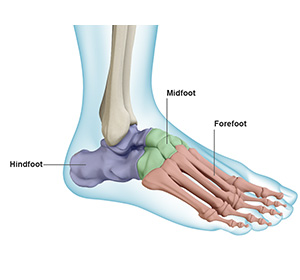
The foot can be divided into three parts: the hindfoot (heel and ankle), midfoot, and forefoot (toes). The midfoot connects the hindfoot to the forefoot, and consists of one navicular bone, one cuboid bone, and three cuneiform bones. The navicular bone is found in front of the heel bone, and the cuneiform and cuboid bones are arranged in front of the navicular bone. These bones are connected to five metatarsal bones of the forefoot that form the arch of the foot for shock absorption while walking or running. As all joints in the body, midfoot joints are susceptible to the effects of wear-and-tear arthritis, necessitating midfoot fusion as a treatment.
Indications for Midfoot Fusion
Midfoot fusion surgery is recommended when non-surgical treatment measures have not alleviated the symptoms of midfoot deformities such as:
- Arthritic conditions such as osteoarthritis and rheumatoid arthritis
- Charcot arthropathy
- Flatfoot deformity
- Severe bunions
- Joint displacement
- Acute trauma or injury
- Severe midfoot fracture
Preparation for Midfoot Fusion
In general, preoperative preparation for midfoot fusion will involve the following steps:
- A thorough examination is performed by your doctor to check for any medical issues that need to be addressed prior to surgery.
- Depending on your medical history, social history, and age, you may need to undergo tests such as bloodwork and imaging to screen for any abnormalities that could threaten the safety of the procedure.
- You will be asked if you have allergies to medications, anesthesia, or latex.
- You should inform your doctor of any medications, vitamins, or supplements that you are taking.
- You should refrain from supplements or medications such as blood thinners, aspirin, or anti-inflammatory medicines for 1 to 2 weeks prior to surgery.
- You should refrain from alcohol or tobacco at least a week before surgery.
- You should not consume solids or liquids at least 8 hours prior to surgery.
- Arrange for someone to drive you home after surgery.
- A written consent will be obtained from you after the surgical procedure has been explained in detail.
Procedure for Midfoot Fusion
In general, midfoot fusion surgery will involve the following steps:
- You will lie on your back on the operating table under regional or general anesthesia.
- One or two surgical cuts are made on top of the foot. The length and the number of incisions will depend upon the number of joints to be fused.
- The underlying muscles are carefully separated to protect the nerves and tendons, and the midfoot joint area is exposed.
- Your surgeon removes any remaining cartilage from the affected joints and prepares the joint surfaces for fusion.
- Stability is accomplished by fusing the joints together with the help of metal implants such as plates and screws. These implants help to immobilize the joints and enable formation of bone across the joint space.
- Bone grafting material may be used to fill up gaps between the bones that may have occurred from the removal of cartilage. The graft material may be taken from another part of your body (autograft) or donor tissue (allograft).
- Your surgeon will also perform any other required repairs in the treatment area.
- Finally, the overlying soft tissue and skin are closed with sutures and sterile bandages are applied.
Postoperative Care and Recovery
In general, postoperative care instructions and recovery after midfoot fusion surgery will involve the following steps:
- You will be transferred to the recovery area where your nurse will closely observe you for any allergic/anesthetic reactions and monitor your vital signs as you recover.
- You may notice some pain, swelling, and discomfort in the foot area. Pain and anti-inflammatory medications are provided as needed.
- Antibiotics are also prescribed to address the risk of surgery-related infection.
- Apply ice bags over a towel to the affected area for about 15-20 minutes to reduce postoperative pain and swelling.
- Do not weight-bear on the operated leg. A walking boot or a non-weight-bearing cast is recommended for a few weeks to facilitate healing and support the foot.
- Assistive devices such as crutches and walkers are recommended to maintain balance and stability while walking for several weeks.
- At least 6 to 8 weeks may be required for the midfoot bones to fuse adequately for you to start weight-bearing on the operated leg.
- Keep the foot elevated at or above the level of your heart to help minimize swelling and discomfort.
- Start rehabilitation (physical therapy) as recommended by your surgeon to improve range of motion. You should begin appropriate exercises to stretch and strengthen the foot muscles.
- Keep the surgical site clean and dry. Instructions on surgical site care and bathing will be provided.
- Full recovery from midfoot fusion will usually take about 6 months to a year. Refrain from strenuous activities and lifting heavy weights for at least 6 months. Gradual increase in activities over a period of time is recommended.
- Return to sports is recommended only when the foot has regained its normal strength and function and with your doctor’s approval.
- A periodic follow-up appointment will be scheduled to monitor your progress.
Risks and Complications
Midfoot fusion surgery is a relatively safe procedure; however, as with any surgery, some risks and complications may occur, such as the following:
- Infection
- Bleeding
- Damage to nerves and vessels
- Thromboembolism or blood clots
- Anesthetic/allergic reactions
- Non-union of bones
- Hardware failure
For more information about our services or to schedule an appointment, call us at or click here to request an appointment online. We'll respond to you as soon as possible.
-
Send a Referral
-
Send Medical Records
-
Additional InquiresEmail us at [email protected]