Internal and External Fixation of Foot and Ankle Fractures
Colorado Springs Orthopaedic Group
Your feet and ankles provide the foundation for movement and are essential for walking, standing, working, exercising, and participating in sports. Injuries and conditions affecting these areas can make even simple daily activities painful or difficult.
CSOG provides specialized care for a broad range of foot and ankle conditions, including fractures, arthritis, tendon and ligament problems, deformities, sports injuries, and other disorders affecting mobility. Our specialists offer both nonsurgical and surgical treatment options based on your individual condition.
Treatment may include physical therapy, activity modification, bracing, injections, minimally invasive procedures, or advanced surgery when appropriate. Our goal is to relieve pain, restore stability and function, and help you get back on your feet and return to the activities you enjoy.
What is Internal and External Fixation of Foot and Ankle Fractures?
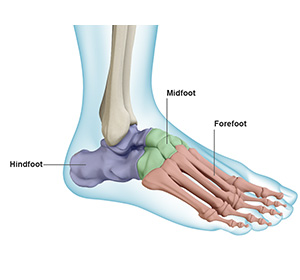
Foot and ankle fractures are breaks or cracks in any bone of your foot and ankle joint. Fixation of fractures is a surgical method of reconnecting the broken or cracked bones and fixing them in the correct place using orthopedic hardware.
Fixation can be:
Internal: Involves the use of devices internally (under the skin) positioned within the patient's body.
External: The devices are screwed into fractured bones to exit the skin and are attached to a stabilizing structure outside the body.
Indications for the Procedure
The main indication is a fracture in one or many bones of your foot and/or ankle. The ensuing indications can be:
- Swelling, tenderness and bruising in the affected area
- Pain that increases whenever you try to stand or walk
- Cracking sounds when you move your foot or ankle
- Decreased ability to move your foot or ankle
- Inability to allow weight on the injured foot or ankle
How to Prepare for the Procedure?
Before the surgery, you may be told to:
- Undergo blood or urine tests and/or x-rays, a CT scan, or an MRI of your foot or ankle
- Stop taking or reduce the amount of medicine (if applicable) for a specific period
- Avoid eating or drinking after midnight the night before the operation
- Arrange somebody to drive you home after the procedure
How is the Surgery Performed?
Fixation of foot and ankle fractures is performed under general anesthesia.
Internal fixation: Your surgeon may use wires, screws, metal plates, nails, rods or pins as orthopedic fixation devices. During the procedure:
- An incision is made on or around your foot or ankle.
- The area is flushed out to remove any loose pieces of bones.
- The broken bones are put back and held together with fixation devices.
- A bone graft may be placed between or around the fracture to fill any defects.
- The incision is closed with stitches or medical tape and covered with bandages.
- A splint or a half cast is applied over your foot or ankle.
External fixation:
- The broken bones are aligned by pushing, pulling, and turning your foot or ankle.
- In cases of hard to reach bones, small cuts may have to be made on your skin.
- Holes are made in your bone above and below the fracture using a drill.
- Using a fluoroscope (live x-ray), screws and long metal pins are inserted through the holes.
- The bones are aligned properly and held together in the proper position.
- The pins sticking out through the skin are attached to a stabilizing device outside.
- Bandages are wrapped around the areas where the pins are inserted and secured.
Risks Associated with the Procedure
Fixation of fractures, either internal or external, comes with certain risks such as:
- Damage to nerves, tissues, other bones or blood vessels
- Stiffness, numbness or weakness in the affected area
- Bone misalignment, improper healing, reduced motion or function
- Infection, bleeding or blood clot in the foot or ankle
- Allergic reaction to the devices, irritation to skin and tissues
- Additional surgery due to device-related issues like looseness
What Precautions should be Taken as You Recover from the Procedure?
As you recover, you may need to:
- Adequately rest your foot or ankle and avoid activities that cause pain
- Follow prescribed physical therapy for a specific period
- Wear a cast, splint or brace that covers your foot and ankle
- Take your medicines and make follow-up visits as directed
- Eat a diet high in calcium and vitamin D as your bones heal
Benefits of the Fixation Procedure
Key benefits of fracture fixation include:
- Stable foot and ankle
- Long lasting pain relief
- Better mobility and function
- Improved quality of life
For more information about our services or to schedule an appointment, call us at or click here to request an appointment online. We'll respond to you as soon as possible.
-
Send a Referral
-
Send Medical Records
-
Additional InquiresEmail us at [email protected]