arp pain '
in' or '
below' your knee cap. The medial collateral ligament (MCL) runs along the inner side of your leg thus, you will experience pain on the '
inside' of your knee.
With both an ACL or MCL injury, you may hear or feel a 'popping' sensation, though ACL injuries traditionally having a more obvious 'pop' than MCL injuries.
Also, know that it is possible to injure your MCL and ACL at the same time. In that case, you could experience most or all the above symptoms.
MCL Injury Symptoms
Symptoms of a less severe MCL sprain or tear may include:
- Tenderness, aching
- Swelling
- Stiffness
- Bruising
Symptoms of a more severe MCL tear may include:
- Significant to unbearable pain
- Instability or looseness of the joint
- Excessive swelling
- Excessive Bruising
- Reduced range of motion
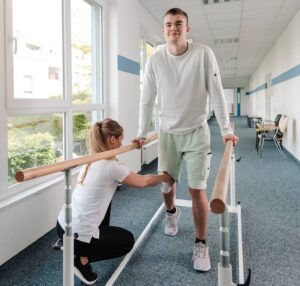
Recovery time depends upon the severity of your MCL injury and whether you have surgery or not:
MCL Injury Recovery (No Surgery)
A mild to moderate MCL injury heals in a few days to several weeks. This is without surgery but is recommended to include rest, self-care such as ice and elevation, bracing or wrapping the knee, and physical therapy.
MCL Injury Recovery (With Surgery)
The sports medicine orthopedic physicians at Colorado Springs Orthopaedic Group believe in exhausting all conservative treatment options prior to discussing surgery. Some of the non-surgical options include physical therapy, cortisone injections, viscosupplementation, or PRP therapy.
If surgery is deemed necessary, then recovery could take four to six weeks after surgery to heal. At that time, you should be able to return to the majority of your normal activities as designated by your physician. However, it may take 6 to 12 months for the injury to heal to full health and integrity. We recommend that you follow your physician's post-operative recovery and therapy protocols attentively. Once the MCL has fully healed, most experience successful long-term results including a full return to sports.If you experience pain and stiffness on the inner side of your knee, it may be a medial collateral ligament (MCL) injury. The pain could be mild to severe, and the injury could be the result of an impact that caused the knee to violently bend or twist inward. Many MCL injuries occur during sports or rigorous physical activity. The ligament can also become injured through repeated stress such as running or jumping.
Your MCL (medial collateral ligament) is a thick band of tissue that runs from your thigh (femur) to your shinbone (tibia) about 4-6 inches from the knee. Its job is to keep the leg from bending too far inward. It also works with your ACL and PCL to stabilize your knee and allows rotation.
When strained too much, the ligament can sprain or tear. In some cases, the MCL can heal on its own and not even be that painful. But in severe cases, the pain can be excruciating, and surgery may be required to repair it.
If you suspect an MCL injury, visit our Express Care clinic to be seen the same day or call us at (719) 632-7669 to schedule with one of our Orthopedic sports specialized orthopedic physicians who specialize in MCL injuries to discuss the best treatment options for your specific situation. Contact our office today to schedule a medical consultation at:
CSOG:
(719) 632-7669
Express Care-
(719) 622-4550
Walk-in Clinic where you will be seen the same day by one of our board-certified Physician Assistants and scheduled with a fellowship-trained physician for a follow-up visit
.
- Grade 1: you have a ligament sprain, but not a tear. You likely do not need surgery.
- Grade 2: you have a partial ligament tear. You may or may not need surgery.
- Grade 3: you have a complete ligament tear. You are more likely to need surgery.
Assessment of an MCL injury should include:
Home therapy for an MCL injury may include:
- Icing/cold packs
- Elevating the leg while resting
- Crutches
- Knee brace
- Anti-inflammatory medication
- Specific stretches and therapy exercises
If MCL Injury Requires Surgery:
Generally, surgery is not required for an MCL injury unless it is a Grade 3 injury or does not heal with home care and therapy. You may also need surgery if you have other combined knee complications.
Cost for MCL Injury Surgery
Please contact your insurance carrier to discuss your specific cost estimates. You can reach our office at
(719) 632-7669 to further discuss payment options.
Procedures
Surgery might be your best option to
repair and/or
reconstruct the knee:
MCL Repair
To repair the MCL, your surgeon will identify the torn portion of the ligament and reattach it to itself or the bone where it tore away from.
MCL Reconstruction
To reconstruct the MCL, your surgeon replaces the damaged ligament with a healthy tendon graft which will then become a new ligament.
Your surgeon may use minimally invasive surgery methods to complete your MCL surgery. This allows for faster recovery time and reduces the chance of infection and excessive scarring.
Benefits
The advantages and benefits of MCL surgery include:
- Pain reduction
- Improved mobility
- Faster recovery
- Reduced muscle atrophy
- High patient satisfaction rates
Risks
The disadvantages and risks of MCL surgery include:
- Infection
- Scarring
- Re-tear of the ligament
To prepare for your MCL surgery, your doctor will give you instructions for the following:
- Medical Exam: This is to make sure you are healthy enough for surgery. A medical clearance form will need to be filled out before surgery.
- Pre-op Appointment: Before surgery, a pre-op appointment will be scheduled to answer any questions you may have and understand the surgery in more detail.
- Medications: You may need to stop taking medications and supplements.
- Diet: You may need to limit certain foods and drink. You will also likely need to fast before surgery and stop consuming all tobacco products.
- Transportation: Arrange to have someone drive you home from the surgery center. This should be a close friend or relative you know well. The vehicle should be easy to get in and out of.
- Clothing: Wear comfortable clothing and shoes that are easy to take off and put on.
- Home: Prepare your home with safety and comfort features. This may include grab bars, ramps, and furniture to help you rest and move about.
What to Expect After MCL Injury
Your postoperative care and instructions may include:
- Medications: CSOG will prescribe a variety of medications to help the recovery go smoothly. Remember that most of these medications are as needed.
- Knee brace: Most knee arthroscopy procedures don’t require a brace however, if you are required one, it will be placed on you before leaving the operating room.
- Control swelling: Elevate your leg and keep using cold compression/ ice packs
- Suggested early rehabilitation exercises
- Pain and anti-inflammatory medications
- Follow up physical exams
Your physician will tell you when you are ready to return to normal activity. For your rehabilitation, your physician will prescribe specific rehabilitative exercises and stretches. This may include:
- Hamstring stretches
- Calf stretches
- Quadriceps isometric strengthening
- Straight leg raises
- Ankle flexing and rotations
- Knee flexion and sitting knee flexion
With these exercises, you do not need to stand or put weight on the surgery leg. As you progress throughout recovery, your physician will request for you to meet with a physical therapist to carry out your physician-prescribed rehabilitation protocols.
During rehabilitation, your exercises will progress with intensity. Be sure to listen to your body. If an exercise becomes painful, stop.
If You Suffer Pain from an MCL Injury
An MCL injury can heal on its own or with therapy; however, if you still have pain and discomfort after proper rest and at-home treatment, call us at
(719) 632-7669 to consult with any one of our Fellowship Trained Knee Specialists to see what treatment options are available to restore pain-free knee function.
Related Articles:
o Physical Therapy for the Knee
o Meniscus Repair Therapy
o Hip & Knee Replacement Testimonials
Christopher Jones, MD
Dr. Jones is fellowship-trained in the treatment of sports medicine injuries and disorders of the shoulder.
Jamie Friedman, MD
Dr. Friedman’s interests include treating a full range of sports injuries and specializes in complex injuries involving the shoulder and knee.
Michael Huang, MD
Dr. Huang specializes in treating orthopedic sports medicine injuries. His treatments involve both surgical and non-surgical options.
John Redfern, MD
In addition to general orthopedic care, Dr. Redfern has a particular interest in arthroscopic and open techniques for shoulder and knee disorders.
Richard Stockelman, MD
Dr. Stockelman’s professional interests include simple and complex problems of the shoulder and the knee.